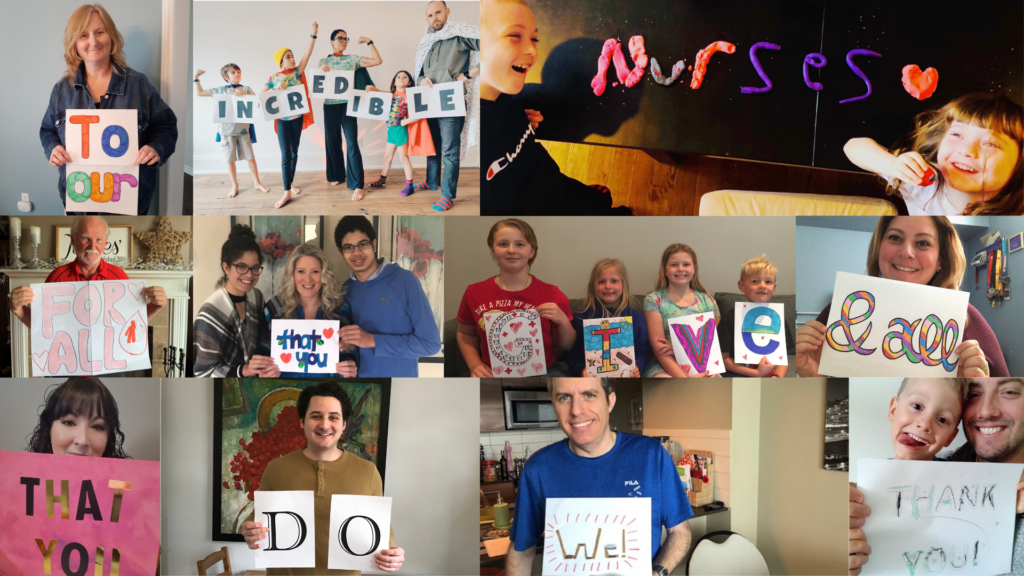
This past week was National Nurses Week. This past year has been harder than most for many in the healthcare field, but we wanted to recognize our nurses and share a special message with them:
To our incredible nurses, for all that you give and all that you do, we thank you!
Thank you for all the time spent, care shown, and support given. Our community would not be the same without you.
If you are immune-compromised or affected by HIV/AIDS, you are NOT required to disclose your status or specify your condition at a vaccination center. If you are asked why you qualify for vaccination you may indicate you have an immunocompromising condition but are not required to specify.
Vaccination and bleeding disorders:
Some public health units have indicated that having a bleeding disorder requires consultation with a doctor before a vaccine can be administered. This is NOT the case. If you have concerns about bleeding from vaccination you should consult with your treatment centre for direction but their permission is NOT required in order to receive a vaccine. Check out our COVID Update for more information.
This is the Association of Hemophilia Clinic Directors of Canada official guidance on vaccination for people with bleeding disorders:
“Encourage your health care to use a smaller gauge needle, if possible, and to apply 10 minutes of pressure after the injection. If you are on prophylaxis with factor concentrate, you should time your prophylaxis with the day of your vaccine injection. If you treat on-demand but have a history of severe bleeding, you may need a treatment with factor concentrate before the vaccine injection. Please contact your bleeding disorder team.”
It is important that hemophilia treatment centres, in close collaboration with patient organizations, take action to inform people with bleeding disorders about the COVID-19 vaccines and contribute to an effective vaccination program.
1. People with bleeding disorders are not at greater risk of contracting COVID-19 or developing a severe form of the disease, so they are not considered a priority group for vaccination.
2. The vaccine should be administered intramuscularly. The smallest gauge needle available (25-27 gauge) should be used, if possible. Some vaccines must be administered using the accompanying needle–syringe combination, and so the use of an alternative needle may not be possible or desirable. Pressure should be applied to the site for at least 10 minutes post-injection to reduce bleeding and swelling. Additionally, self-inspection/palpation of the injection area several minutes and 2-4 hours later is recommended to ensure that there is no delayed hematoma. Discomfort in the arm felt for 1-2 days after injection should not be alarming unless it worsens and is accompanied by swelling. Any adverse events (e.g., hematoma, allergic reaction) should be reported to a hemophilia treatment centre.
3. Patients should contact their physician immediately or go to the nearest hospital emergency room right away if they experience an allergic reaction (fever, warmth, redness, itchy skin rash, shortness of breath, or swelling of the face or tongue) as it can be life-threatening. Patients with a history of allergic reactions to extended half-life clotting factor concentrates containing polyethylene glycol (PEG) should discuss vaccine choice with their physician because some vaccines contain PEG as an excipient.
4. Many individuals with bleeding disorders may not have ready access to hemostatic therapies prior to vaccination. In these cases, make efforts to access other clotting factors if possible. Alternatively, follow the instructions above making sure the smallest possible needle is used and maintain pressure for more than 10 minutes.
5. For patients with severe/moderate hemophilia, the injection should be given after a factor VIII (FVIII) or factor IX (FIX) injection. For patients with a basal FVIII or FIX level above 10%, no hemostatic precautions are required.
6. Patients on emicizumab (with or without an inhibitor) can be vaccinated by intramuscular injection at any time without hemostatic precautions and without receiving a dose of FVIII.
7. Patients with Type 1 or 2 Willebrand disease (VWD), depending on their baseline von Willebrand factor (VWF) ristocetin cofactor (RiCof) activity levels, should use therapies (i.e., DDAVP if available, tranexamic acid), in consultation with their hemophilia treatment centre. Patients with Type 3 VWD should be given a VWF-containing injection.
8. All rare bleeding disorder patients (including those with thrombocytopenia and/or platelet function disorders) should be vaccinated. Patients on anticoagulants should have prothrombin time testing performed within 72 hours prior to injection to determine international normalized ratio (INR); if results are stable and within the therapeutic range, they can be vaccinated intramuscularly.
9. There are no specific contraindications to vaccination related to complications of hemophilia and other bleeding disorders or their therapies. Immune tolerance, treatment of hepatitis C and HIV, and other conditions do not contraindicate vaccination.
10. Vaccination is not contraindicated for patients on immunosuppressive agents (cortisone, other immunosuppressive drugs).
11. Potential contraindications should be discussed individually with the physician because recommendations vary in different jurisdictions due to lack of data in special populations (e.g., pregnant or breastfeeding women).
12. The U.K. Medicines and Healthcare Products Regulatory Agency and the U.S. Centers for Disease Control and Prevention have advised caution in using the Pfizer/BioNTech vaccine in people with a history of significant allergic reactions. Specific recommendations for people with a history of allergic/anaphylactoid reactions can be found in the advisory published by each agency.
13. For patients in a clinical study, vaccination should be reported to the study investigators.
Parents Empowering Parents is a program designed to give parents of children with bleeding disorders a chance to meet with other families, to share parenting tips, and to receive specialized programming geared at building new skills and navigating the complicated parenting situations that sometimes come with being a caregiver to a child with a bleeding disorder.
Leading the program will be a trained parent facilitator supported by a clinic social worker to guide the sessions. Sessions are for parents and will take place on a weekend, with programming starting on Friday evening and concluding on Sunday afternoon. Hemophilia Ontario will be developing parents empowering parents programming in a number of regions in Ontario depending on community interest. Dates and venues are currently TBD for 2021 due to COVID-19 restrictions, but will be announced as soon as provincial guidance allows. If this sounds like a program for you, we encourage you to reach out to us directly at info@hemophilia.on.ca for more information, or call 647-354-5660 to speak to a staff member.
The WFH Guidelines for the Management of Hemophilia offers up-to-date guidance and practical recommendations on the diagnosis and management of hemophilia, including the management of musculoskeletal complications and inhibitors, updates to laboratory diagnosis and genetic assessments, and new recommendations on outcome assessments. Now, for the first time, all this information has been gathered together in the new WFH Treatment Guidelines (TG) Resource Hub. With the click of a mouse, you can get easy access to critical information such as key messages, short narrated videos, slides and easy-to-read documents.
It’s National Volunteer Week and Hemophilia Ontario would like to thank all of our wonderful volunteers. Thank you for your time, expertise, and dedication. Your work is making a difference in the lives of people in our community.
If you would like to learn more about us, please visit Missions and Values to learn more about what we strive to achieve at Hemophilia Ontario.
How To Become a Volunteer?
If you would like to become a volunteer at Hemophilia Ontario, please contact Susan Turner at sturner@hemophilia.on.ca
We hope everyone is joining us for our World Hemophilia Day Celebration at 1pm on April 17th! You can register here. In addition to running an event to celebrate, Hemophilia Ontario also participated in an interview for mediaplanet https://mediaplanet.com/ca/ that showcased women’s bleeding disorder for World Hemophilia Day.
Our goal is to raise awareness for women’s bleeding disorders and this was a wonderful opportunity to partner with Dr. Paula James, (Hematologist, Department of Medicine, Graduate Program Director, Translational Medicine, Queen’s University) and answer some questions, dispel some myths and inform about programs and resources.
Thank you to Everyone who Joined our March Movement Challenge!
With your help this fundraiser was a great success! You raised $3911.00 to support programs and services for members of Hemophilia Ontario’s bleeding disorder community!
Winners of the top three prizes for most donations raised:
* 3rd Prize: $150 Sport Chek Gift Card – Winner – The Menard Family
The Winners for the Random Participation Draw for all those who registered:
* Jean Holmes
* David Holmes
* Tanya Riemann
* Alec Lehto
Each winner will receive a $25 Amazon Gift Card for registering to participate in the March Movement Challenge!
Hemophilia Ontario thanks everyone who participated, registered, raised donations and got moving for the month of March! We encourage you to keep moving and stay active!
Get your friends and family moving and join us for our March Moves Challenge to help us raise funds for Hemophilia Ontario. Pick a goal that is right for you and start moving!
You can choose between reaching 100 minutes, 200 minutes or an amazing 400 minutes of movement – just hit your goal between March 1st and March 31st.
Movement can be any form of physical activity of your choice – walking, running, chair yoga, weights, stationary bike, up and down the stairs, be creative! You can even do a variety of activities to reach your goal!